Sahel: achievements and new initiatives
© Studio Theyes

LuxDev has been supporting Senegal, Mali and Burkina Faso in their development efforts since the late 1980s. Built on long-standing partnerships based on trust, mutual commitment and the strengthening of national systems, the programmes funded by Luxembourg Development Cooperation in this part of the Sahel came to an end on 31 December 2025. They leave behind tangible results, reflecting improved living conditions for local populations and strengthened national capacities in key sectors. While Luxembourg’s interventions came to an end, others are beginning, supported by European funding and demonstrating the Agency’s continued commitment to the region.
-
43,3 MEUR disbursed
in 2025 in the Sahel region
-
14 interventions
in 2025 in the Sahel region
Health, a gateway
It was in Senegal, in 1987, that Luxembourg initiated its cooperation with a Sahelian country, by committing to the rehabilitation and expansion of the Saint-Louis Hospital. Since then, health has remained a priority sector, as evidenced by the most recent initiative.
Implemented between 2018 and 2025, the Health and social protection programme helped to strengthen the emergency management chain. Thanks to structural investments and local support, nearly 12,000 patients were coordinated by the SAMU, while call reception and dispatch centres were set up in four strategic regions of the country. Hospital capacity were enhanced through the refurbishment and equipping of emergency departments, intensive care units and operating theatres, as well as through the deployment of 22 fully equipped ambulances.
At the same time, the skills of more than 1,000 healthcare professionals were strengthened through the establishment of a simulation-based training centre for emergency care procedures, the development and dissemination of emergency care protocols, and the awarding of some 140 training grants.

Gallery viewer


In parallel, the programme achieved tangible results in the prevention and management of non-communicable diseases: the proportion of patients screened for hypertension rose from 0.89% to 2.04%, while thousands of people were made aware of the risks associated with diabetes and cancer.
Finally, in the area of social protection, support for the professionalisation of mutual health organisations and the establishment of departmental health insurance units helped to improve the services provided and financial access to healthcare. As a result, the penetration rate of mutual health organisations reached 97.8% (compared with 73% prior to the intervention) and user satisfaction rose from 68% to 80%.
Gallery viewer


Testimonial: better emergency care in Kaffrine
Dr Christophe KANFOM recalls the constraints the health centre faced before the programme built and equipped a new emergency reception unit.
We used to have a very cramped emergency reception area, with only three or four beds and no wall-mounted oxygen supply. For many patients in shock or suffering from respiratory distress, it was difficult to provide care, and referrals to the regional hospital were frequent. Today, thanks to wall-mounted oxygen, these situations are better managed and patient transfers have decreased significantly. People are very satisfied, as the services are welcoming and provide everything they need: a good reception, a clean environment and qualified staff.
Dr Christophe KANFOM
Chief Medical Officer of the Kaffrine Health District
Highlight
Launched in 2018 with a budget of EUR 82.7 million, the 4th Indicative Cooperation Programme between Senegal and Luxembourg came to an end in late 2025. To celebrate nearly seven years of partnership, a series of events was organised, beginning with site visits to projects supported under the Health and social protection and Vocational and technical training and employability programmes. In early December, the Kaolack Regional Blood Transfusion Centre was inaugurated in the presence of numerous dignitaries. A few days later, the exhibition ‘Jaar-Jaar, pathways to change’, round-table discussions and a wrap-up workshop provided an opportunity to review the results achieved across the nine regions of intervention.

Strengthening agricultural value chains: a regional priority
In Mali and Burkina Faso, LuxDev supported the agriculture and forestry sectors to improve food security, protect the environment and strengthen local economies. In a complex socio-economic and security context, these initiatives promoted sustainable land management and more productive and inclusive agriculture, through an approach combining the development of high-potential value chains, training and access to finance.
Strengthened value chains
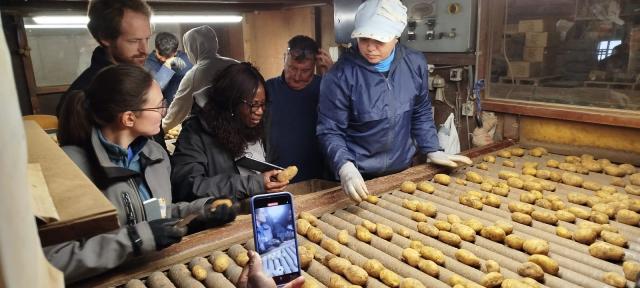
In Mali, agro-pastoral family farms and micro, small and medium-sized enterprises (MSMEs) benefiting from the Agency’s programmes saw their production increase. These results were underpinned by on-the-ground support, access to modern equipment, and the dissemination of best practices and technical innovations.
Between 2020 and 2025, potato yields rose from 18 t/ha to over 22 t/ha, while average milk production more than doubled. These advances translated directly into economic gains for producers. Annual incomes increased by around 42% for dairy farmers and by more than 300% for potato producers.
To facilitate market access, support mechanisms for local producers were put in place, supplemented by the organisation of business events. These initiatives led to the signing of over 50 contracts across the market gardening, livestock fattening, rice and sesame value chains.
Gallery viewer


Training and financing to promote youth employment
Promoting young people’s integration within their home regions is a key priority of these interventions. To this end, significant efforts were made to support vocational training and access to finance for young Malians.
In this context, 2,470 workers (52% of whom were young women) were trained in the local dairy and potato value chains, and 1,008 young people were provided with financial support to develop private initiatives. In addition, 27 innovative projects based on technological and environmental solutions were funded amounting to XOF 279 million, enabling their leaders to integrate into the agricultural sector.
Gallery viewer


Better preservation of natural resources
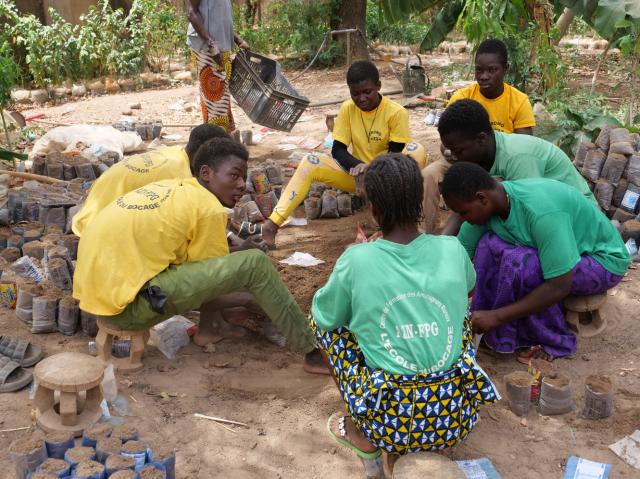
In Burkina Faso, the support programme for the sustainable management of forest resources – implemented in a context of climate vulnerability and accelerating land degradation – strengthened sustainable land management through the development of several management plans and the securing of 15,720 hectares.
Over seven years, the restoration of 4,420 hectares of degraded land, including 2,301 hectares in 2025, along with the development of Sahelian hedgerow systems, enabled 153 families to settle and regenerate soil fertility.
The programme also integrated environmental education – a driver of behavioural change – into 58 schools, trained 404 trainers and contributed to strengthening national governance frameworks.
-
Closed Mali
Support to agropastoral value chains - Phase II
Agriculture, forestry and fishery
Support to agropastoral value chains - Phase II -
Closed Burkina Faso
Support to the sustainable management of the forest resources
Agriculture, forestry and fishery
Support to the sustainable management of the forest resources


Vocational training: ensuring continuity
In the Sahel, vocational training is a key lever for inclusion and access to employment, particularly for young people and women. However, education systems struggle to meet local economic needs, leaving many young people without adequate skills, particularly in rural areas.
LuxDev works across the entire education-training-employment continuum to enable them to engage in stable, income-generating activities, thereby contributing to the development of the local economy. The results achieved in recent years reflect this momentum.
Expanding access to education
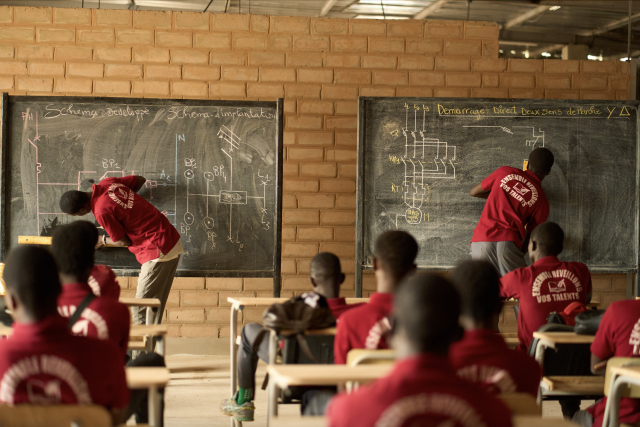
The programmes implemented in the region have, first and foremost, improved access to education. In Senegal, during Indicative Coopeeration Programme IV, nearly 15,000 young people benefited from vocational training in promising sectors. To reach the most remote communities, nine mobile training units – effectively schools on wheels – were deployed in isolated areas.

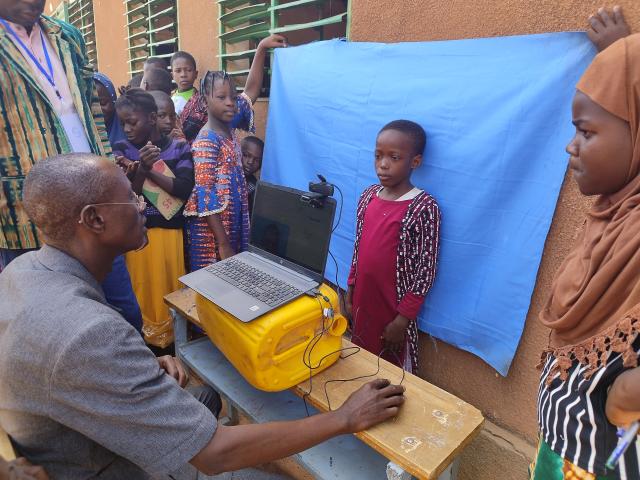
In Burkina Faso, the Support programme to implementation of the Education and Training Sector Plan, carried out between 2018 and 2025, contributed to ensuring educational continuity in regions facing insecurity. In 2025 alone, 165 classrooms were built and equipped, 19 temporary learning facilities were modernised, and nearly 2 million meals were distributed, improving learning conditions in 267 schools for the benefit of 320,000 pupils.
Gallery viewer


Strengthening career guidance
Crucial to young people’s futures, career guidance received particular attention. Launched in September 2025 in Senegal, the Yaay Choisir (‘It’s your choice’) campaign helps combat gender stereotypes by promoting science, industry and agropastoral sectors among girls. Built around a documentary series designed to inspire and raise awareness, it reached over 12 million people.

In Mali, more than 6,400 young people benefited from personalised support to map out pathways aligned with their skills and job market needs.
Gallery viewer


Aligning training with labour market needs
At the same time, training provision was thoroughly redesigned to better reflect economic realities. In Senegal, eight programmes have been co-developed with companies operating in growth sectors (information and communication technologies, agri-food, construction). This skills-based approach enabled around 4,300 young people to acquire directly applicable skills, and nearly 70% of them entered the labour market.

© Phototigui
Promoting entrepreneurship
Support for economic empowerment complements these efforts by providing young people with the means to create their own activities. Through the various interventions carried out in Mali, more than 3,000 people were trained in entrepreneurship, management and financial literacy, strengthening their ability to sustain their projects. The results are encouraging: nearly three quarters of the beneficiaries were still running their businesses six months after launch, a strong indicator of economic viability. In the same vein, support provided to more than 5,500 young people in Senegal, combined with the granting of 874 loans, significantly increased the medium-term employment rate, from 34% to 53% over 12 months.
Beyond their impact on direct beneficiaries, these interventions contributed to lasting systemic change. By strengthening sector governance, the capacities of training institutions and management tools, LuxDev supported its national partners in building more autonomous, locally adapted and sustainable systems.
-
Closed Senegal
Vocational and technical training and employability
Education, vocational training and employment
Vocational and technical training and employability -
Closed Burkina Faso
Support programme to implementation of the Education and Training Sector Plan (PSEF)
Education, vocational training and employment
Support programme to implementation of the Education and Training Sector Plan (PSEF) -
Closed Mali
Technical and vocational training
Education, vocational training and employment
Technical and vocational training


European projects take over
After 2025, LuxDev will continue its work in the Sahel in the area of training and labour market integration. The Agency is already building on previous achievements through new initiatives (co-)funded by the European Union.
In Senegal, the FIT ! Senegal Initiative is in full swing. Aimed at promoting vocational training, particularly in sectors linked to the Youth Olympic Games to be held in Dakar in 2026, the initiative launched the national skills competition TerangaSkills. In the run-up to the Games, the regional rounds attracted more than 25,000 spectators, who came to cheer on 350 young talents competing in disciplines such as catering, sewing, agricultural product processing, plumbing, electrical installation, carpentry and metalwork. This immersive experience helped to change perceptions of technical fields, which are now seen as rewarding and offering significant opportunities.

In Burkina Faso, the BenkadiBaara – All Together for youth employment ! programme promotes the development of a green economy that generates decent jobs. In 2025, 132 training and labour market integration projects were selected, benefiting 12,000 people, with a focus on agro-silvo-pastoral, agri-food, renewable energy, (eco-)construction and public works, and mechanical sectors. Launched in 2024, the programme is already supporting 13,000 young people into employment.

Finally, 2025 was marked by the launch of the Vocational training for youth in Mali project, known as Chifinw ka baarasira (‘Young people’s path to employment’). Aimed at improving employability and labour market integration in the regions of Kayes, Koulikoro, Sikasso and the district of Bamako, the project adopts an approach based on alignment with labour market needs, private sector engagement and the inclusion of vulnerable groups. In 2025, efforts focused on conducting territorial and sectoral assessments, identifying training providers and partner companies, co-developing the first training-to-employment schemes, and launching pilot programmes. In addition, 435 young people were selected to join, from the first quarter of 2026, training and integration pathways targeting high-potential green and greening sectors (such as photovoltaics, gum arabic, agri-food processing, aquaculture and certain digital professions).
